Mobile 3D training · Southern University Mobile CAVE, presented with XR Jags · Baton Rouge
Training built for your discipline, run at your site.
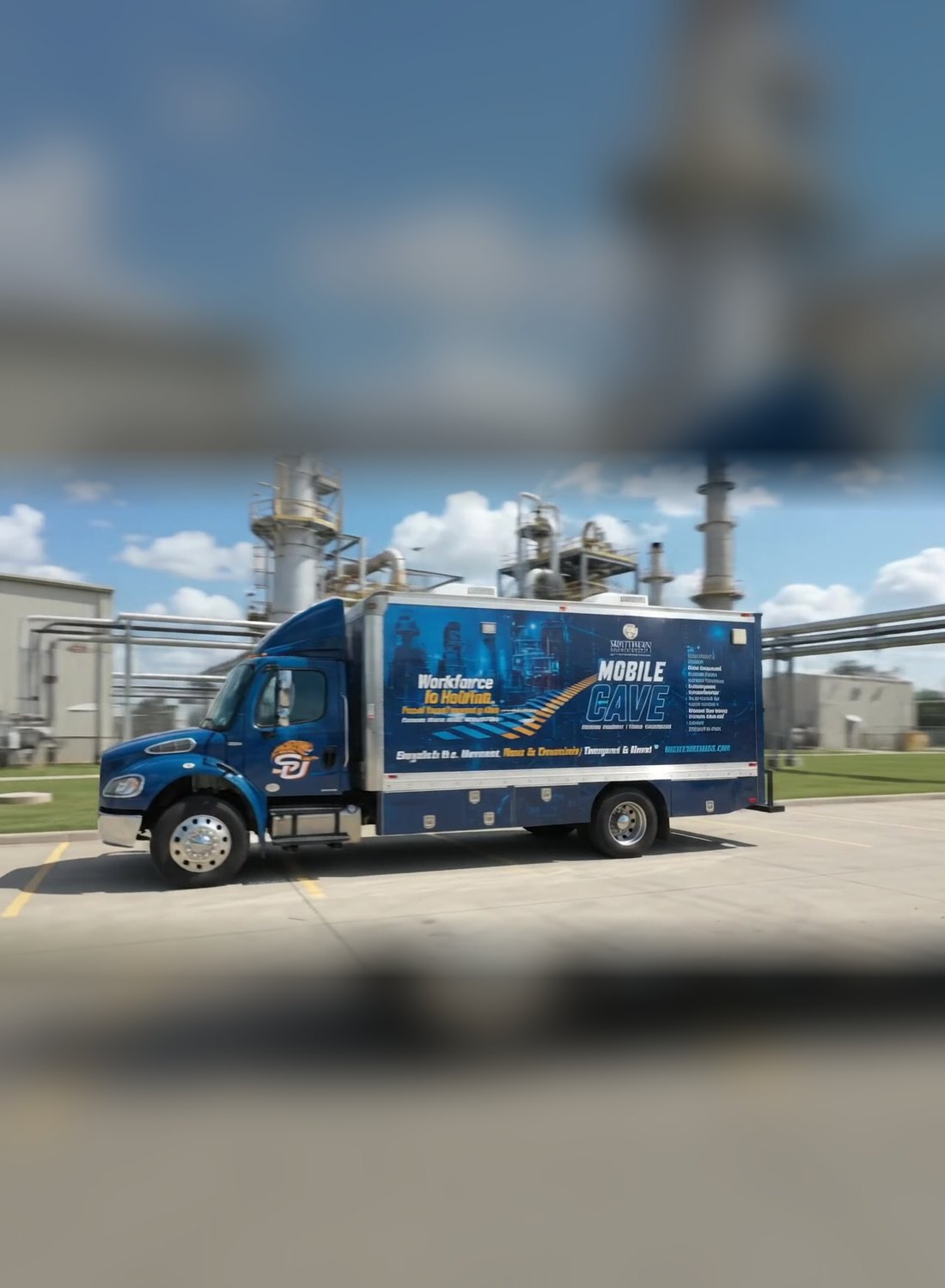
Your plant’s shutdown, your hospital’s rare case, your parish’s storm plan: built as a 3D scenario your own people practice where they work. The Southern University Mobile CAVE brings it to you.
TBA
Launch event · date to be announced
Ribbon cutting and live 3D demos at the Leon Waters Museum, Southern University

Workforce of Tomorrow
Ten films: where the training goes and what each discipline practices.
Four films show where the training goes. Six show what each discipline practices inside, one for each training sub-project (SP-01 to SP-06). The ring turns on its own, muted. Drag, swipe or use the arrows to turn it yourself: that switches on the sound of the film in front, and the Sound button turns it off. Tap a film to watch it full size.
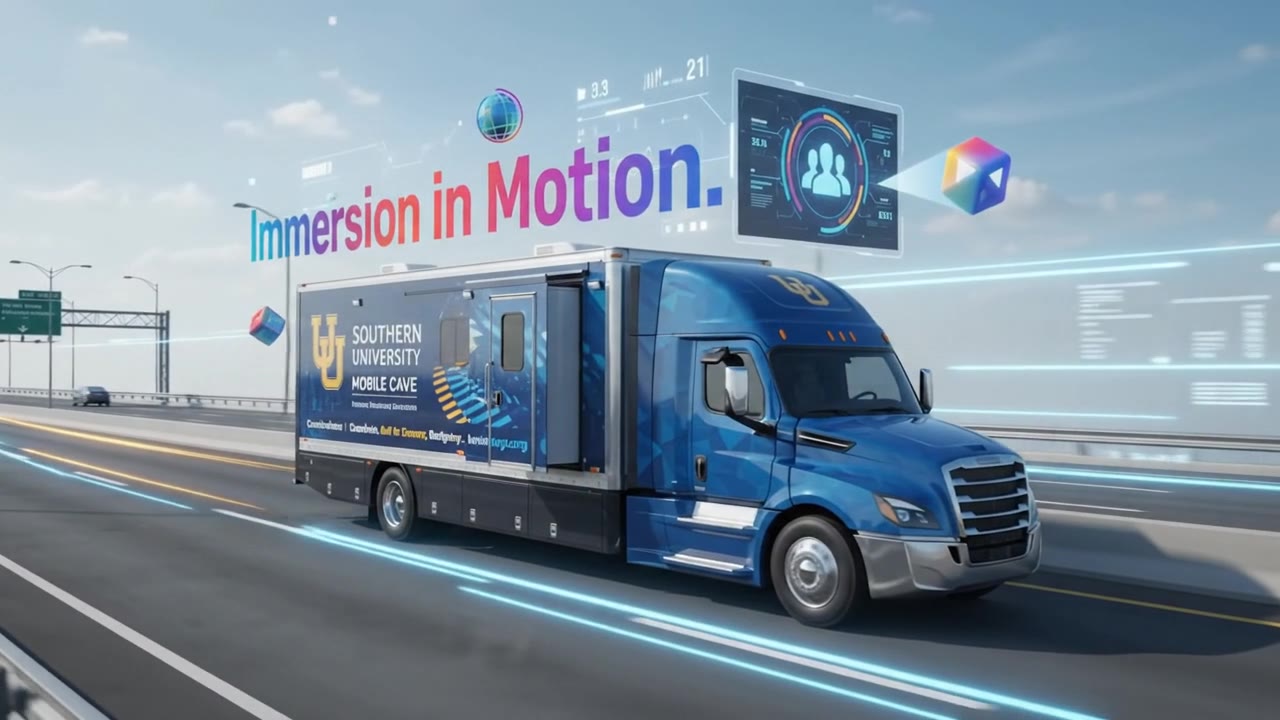
AI-made films, not footage of the real truck.
What it is
One training lab, built for each discipline.
K-12 science, crisis and emergency, healthcare, research, manufacturing, drones, plus the student operations team that runs the Mobile CAVE (sub-projects SP-01 to SP-07). The Southern University Mobile CAVE (Cave Automatic Virtual Environment) is described by the university as a one-of-a-kind, transportable immersive research and training lab, conceived and led by students from concept to completion and outfitted by industry experts.
Classroom learning expanded through real-world, hands-on virtual experiences.
A mobile platform for interdisciplinary research and simulation.
Prepares students for high-demand careers in emerging technologies.
Brings advanced training and simulation to schools, communities and industry partners.
The training goes to the learner’s own site.
Academia, industry and government, with wider access to immersive technology.
The thing it actually does
Interactive learning: the learner acts, the room answers.
A video explains. A simulation lets you try, get it wrong, see what happens, and try again. That loop is the point.
try it. miss. try again.
Walk inside your science unit
Shrink to the size of a cell, stand in a river delta, watch a reaction from the inside. The class moves things in its own unit and sees what changes, instead of copying a diagram.
Practice your site’s dangerous day safely
A new hire runs your plant’s emergency shutdown, spots your hazards, or walks a drone inspection of your assets, and a mistake costs nothing. The crew does it again until it is automatic.
Rehearse your rare, high-stakes case
Run the scenario your team seldom sees in a placement: the crash, the surge, the difficult conversation. Teams repeat it and compare notes in the debrief.
Eight training fields are covered, from K-12 science to drones. The scenario for your site is built or licensed with you before your demo.
What gets in the way, and what removes it
Barriers in science, technical training and healthcare.
The barriers trainers in each field run into, and what changes when the training is built for that discipline and run on site. Tell us what we missed in the form below.
Who can use it
Any place where people must learn something that is hard to practice for real.
Twelve kinds of organizations, each with its own training need. If yours is not here, ask.
Industrial plants and manufacturers
Training pulls people off the line, and the emergencies that matter are the ones crews rarely get to practice.
Page for clientsSkilled-trade contractors
Electricians, pipefitters, welders, millwrights and instrument technicians need safe practice before their first day on a live site.
Page for clientsUtilities, pipelines and energy
Inspections and emergency response are costly to stage and hard to rehearse.
Page for clientsHospitals and health systems
Staff cannot leave the floor for a day, and rare cases seldom come up in practice.
Page for clientsNursing, EMS and allied-health schools
Clinical placements are limited and simulation labs are costly.
Page for educationK-12 schools
Many schools have no lab, and some students struggle with text-heavy science lessons.
Page for educationColleges, technical schools and universities
Workforce programs need hands-on practice that students can repeat.
Page for educationEmergency management, fire, police and parish government
Crisis plans are tested rarely, and live exercises cost a great deal.
Page for rural councilsWorkforce boards and veteran services
People with real skills need a way to show them before the first interview.
Page for workforce programsPorts, logistics and airports
Safety and equipment drills on busy sites are hard to schedule.
Page for clientsInsurers, safety consultants and industry groups
They want fewer incidents and better-trained clients and members.
Page for partnersNonprofits, churches, libraries and youth programs
Families want STEM nights and career exposure close to home.
Page for partnersA page written for you
See it
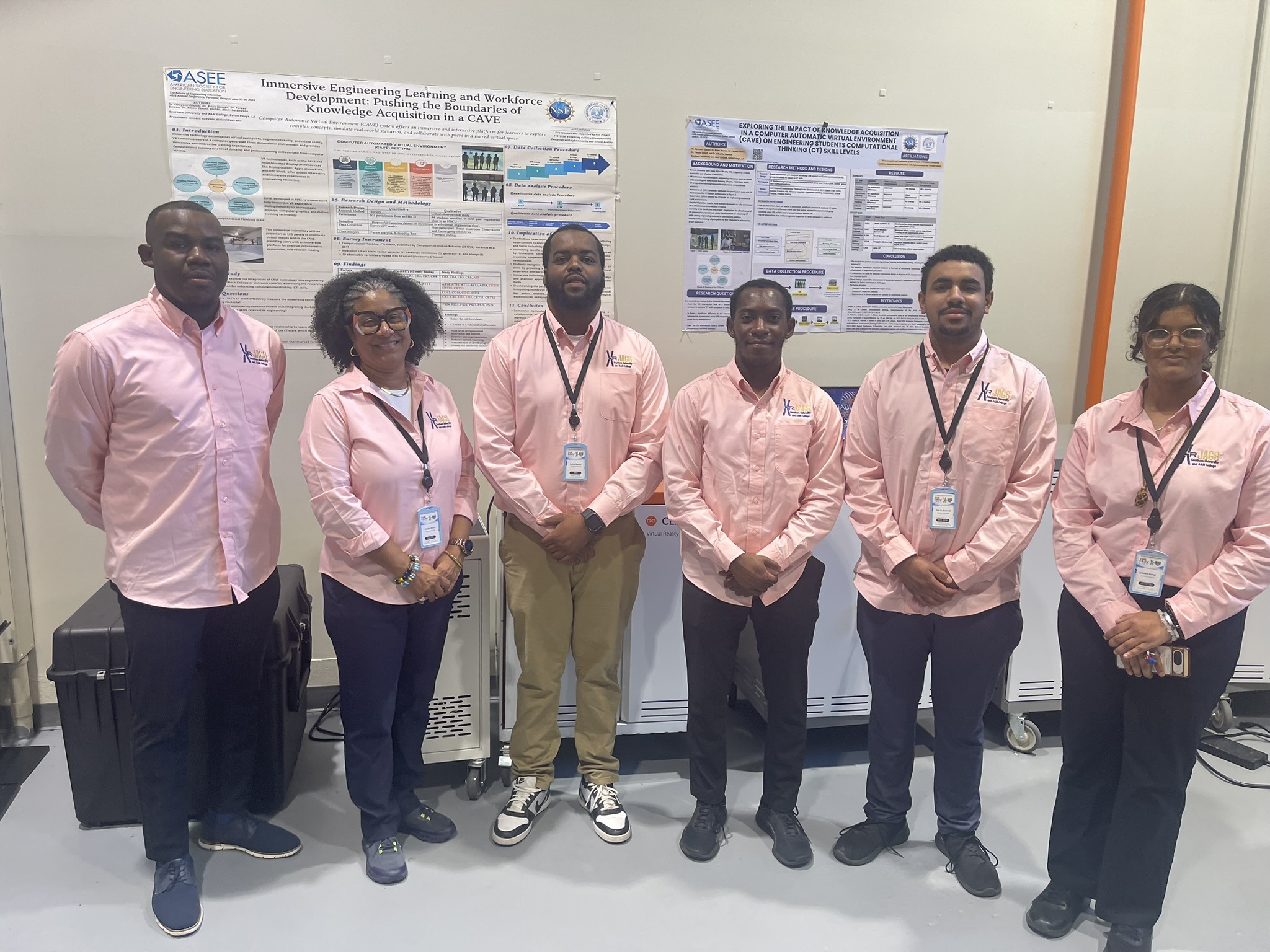
How the training reaches you, and the student team behind it.
Evidence
What published research says.
Faster, more confident, cheaper at scale
- Learners trained up to 4 times faster than in a classroom.
- Up to 275% more confident applying what they learned.
- Up to 4 times more focused than e-learning peers.
- Content costs up to 48% more to build, breaks even with classroom at 375 learners, and at 3,000 learners is 52% cheaper.
The need is large and local
- $154 billion in industrial projects in the pipeline across New Orleans, Baton Rouge and Lake Charles (economist figure quoted in the article).
- Up to 5,400 more industry workers needed: 2,000 electricians, 500 instrument technicians, 700 millwrights, 2,200 pipefitters and contract welders.
Sponsors and workforce partners
Put your name on the training that reaches your community.
Support a student-led initiative that advances education, workforce development, research and community impact across Louisiana and beyond.
Vehicle logo recognition
Your logo travels on the Mobile CAVE to every plant, school and community stop.
Brand visibility at events and tours
Named at the grand opening and at stops on the tour.
Workforce development partnerships
Early access to trained candidates, including veterans.
STEM and community outreach
Your name on school science visits and community nights.
Research and innovation collaboration
A say in which training scenarios are chosen and built.
Results reports
A short note after each stop: who tried it, what they said, what is next.
Sponsorship packages
| Package | What it includes | Best fit |
|---|---|---|
| Presenting | All benefits above, lead logo position, a named moment at the grand opening | A plant owner or a health system |
| Workforce | Workforce partnership, event visibility, vehicle logo | Plants, contractors, staffing firms |
| Community | STEM and community outreach, event visibility | Banks, foundations, local businesses |
| Supporter | Event visibility and a listing on this page | Small businesses and individuals |
Ask the project director for package amounts.
Deidre Hardy Street, Project Director
Southern University, Office of Research and Strategic Initiatives
Service requests
Request a service from the Southern University team.
3D printing requests, training requests and other service requests go through one form, hosted on the XR Jags site.
3D printing requests
Ask for a part, a model or a print run.
Training requests
Ask for a training session for your group.
Other service requests
Anything else you need from the team. Tell us in the form.
Book a demo or ask about sponsoring
Tell us your field, your site and what stops you.
We answer every request. The last question matters most. It tells us which scenario to build for you.